This painting started with a simple observation: the mind isn’t made of thoughts alone—it’s made of the pauses that hold them apart.
I imagined a figure standing at the edge of a threshold, not escaping, not arriving—just listening. Behind her, the surface breaks into layers: coral heat, salt air, ash-soft blues, and a drifting cluster of spheres like unspoken sentences. They aren’t memories exactly. They’re the afterglow of them—the way a moment continues to float long after it’s passed.
Above, a thin horizon line and a distant city sit like the “outer world,” faint and far—present, but not demanding. The real event is closer: where the body leans into quiet, where the colors behave like weather, where the space between one thought and the next becomes a room you can step into.
The title came last. The Spaces Between Thoughts isn’t about emptiness. It’s about permission—the small interval where nothing is decided yet, and something new can rearrange itself without being forced.
This painting started with a simple observation: the mind isn’t made of thoughts alone—it’s made of the pauses that hold them apart.
I imagined a figure standing at the edge of a threshold, not escaping, not arriving—just listening. Behind her, the surface breaks into layers: coral heat, salt air, ash-soft blues, and a drifting cluster of spheres like unspoken sentences. They aren’t memories exactly. They’re the afterglow of them—the way a moment continues to float long after it’s passed.
Above, a thin horizon line and a distant city sit like the “outer world,” faint and far—present, but not demanding. The real event is closer: where the body leans into quiet, where the colors behave like weather, where the space between one thought and the next becomes a room you can step into.
The title came last. The Spaces Between Thoughts isn’t about emptiness. It’s about permission—the small interval where nothing is decided yet, and something new can rearrange itself without being forced.

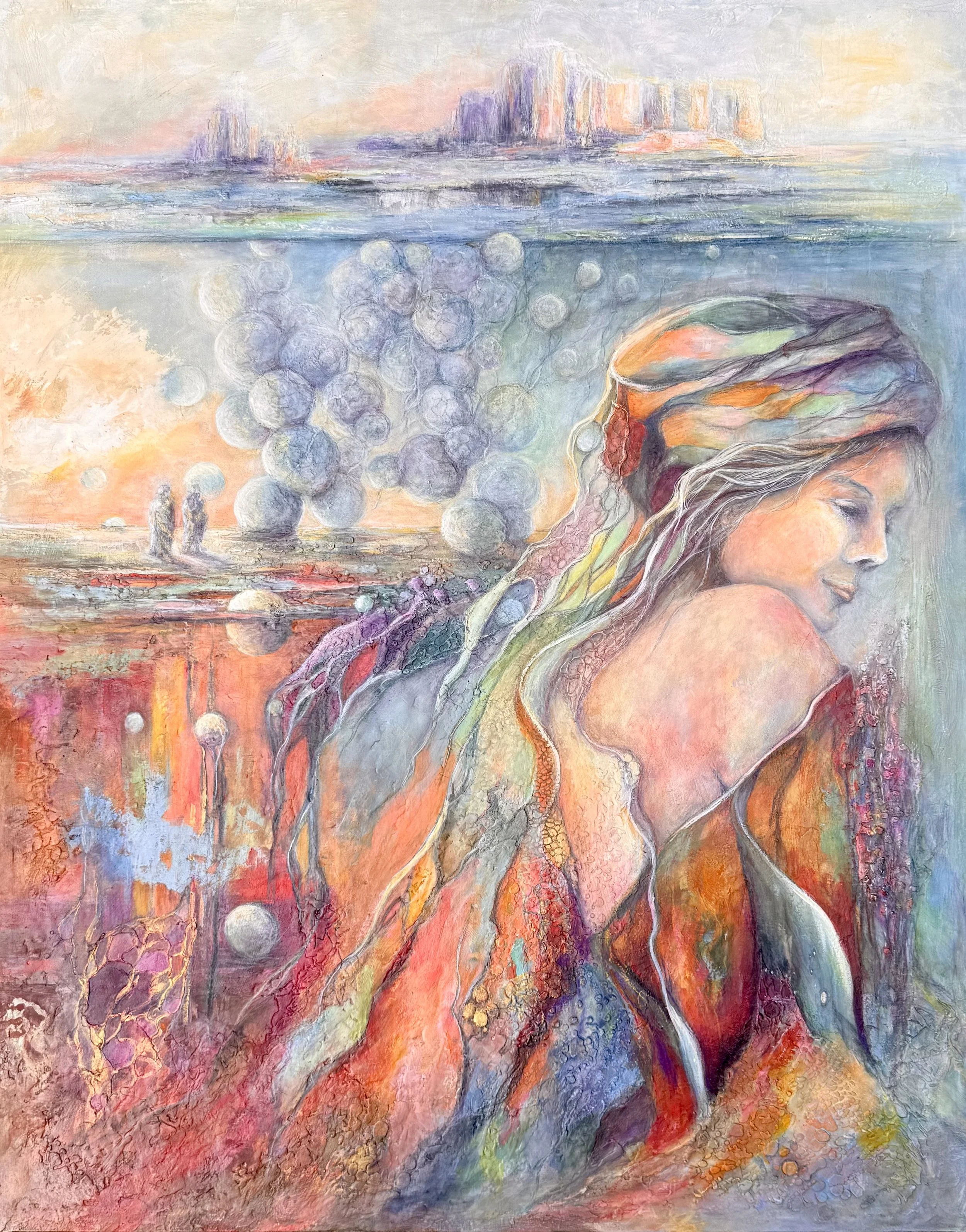 Image 1 of 1